MAY LIN





MULTIMEDIA JOURNALIST OF THE YEAR PORTFOLIO
PERSONAL STATEMENT
When we think of advocacy, we often think of loud movements. Big movements. People with vigor, leadership, and risk. Crowded protests, grand speeches, and organized strikes.
We almost never think of the media, in its various shapes and forms. We don’t think about how journalism is not just about writing stories or sharing news, but about speaking up for people who are unable to speak for themselves.
That is the mindset I have when I create — whether it be an article, a chart, an infographic, a podcast episode, a video, a photo, or a spread design — it’s not about what, but about how. How can I effectively, accurately, and authentically convey the story of someone or something that has been suppressed for so long?
The answer is multimedia.
Writing: Of course, we must start from the very beginning of every journalist’s career — writing. The baby steps, pulling all-nighters to write ledes and kickers. After writing my first feature on neurodivergent siblings, a girl whose brother has Down syndrome tells me, “I have never felt so represented before.” My second feature on surviving suicide, someone tells me, “You saved my life.”
It’s writing that made me come to the realization that the media we consume shapes what we fight for, even if it be our own lives.
I see myself in every feature I write — Alissa Zhang*’s struggles with her mental health, Ian Moran’s determination to preserve his craft, and Scott Wallace*’s intricate relationship with his autistic brother. I write to fight for those who are just like me. To take the people who are overlooked and bring them into existence.
Data: A Flourish infographic with local programs to support neurodivergent siblings, a resource I wish I had when I was younger. Charts and maps that communicate the exigency of the adolescent mental health crisis. When SNAP benefits were cut off in September 2025, a simple map made on Knightlab listed dozens of restaurants across the Bay Area providing free or reduced meals, ensuring that families weren’t left unfed.
To me, the biggest honor isn’t winning a Best of SNO or a first-place award. It’s the texts. The emails. The messages from people, often strangers, who felt seen, heard, or understood because of something I created. It’s knowing that my work has reached someone out there — even if it’s just one person — and perhaps made them see the world a little bit differently.
Broadcast: At first, I hated it. Even during an exciting morning of filming at the Sequoia Union High School District Central Kitchen from 4 a.m., all I could think about was how much I was dreading editing later — which shots I would need, how long the standup would take, and how difficult Premiere Pro was to use.
That was until San Carlos Hometown Days. For the first time, after a semester of practicing broadcast videos, I wasn’t worried about getting the perfect B-roll or having crisp, clean audio. I was simply focused on the people in front of me. I saw their tired but bright eyes, glistening as they passionately explained what their booth was about. Conversations that might’ve lasted 30 seconds turned into 5-minute interviews. Strangers became storytellers, and from that initial connection, all the technical aspects followed.
So, beyond impacting others, the medium of broadcast is truly for me — it has allowed me to flourish into the confident multimedia journalist that I am today. And yes, I do still mess up in my standups, an awkward stutter turning “Hometown Days” into “Hometowns Day,” but I have become much more comfortable with these insignificant failures.
Design: As someone who tends to always do too much, writing a 6000-word feature on the art of preservation that had to be split into three separate stories, design taught me the balancing act of creativity. Sometimes, too much can distract from the story just as much as too little. Through my experience as a Highlander editor this year, which I will take with me next year as Managing Editor, I’ve learned when to add another visual element, when to fill the white space with color, and when to let a photo speak for itself.
Alas, the ability to speak and be understood is a privilege that many of us take for granted. To open our mouths, shout into the fire without consequence, and make ourselves heard. So, whether it be speaking up for survivors of suicide, neurodiverse siblings, whistleblowers, Asian American children, SNAP recipients, or traditional artists fighting to keep their craft alive, to me, multimedia journalism is an act of amplification.
Even though each medium carries the message in a different way, the purpose remains the same: To give others a platform, to allow their voices to travel farther than they ever could alone.


VIDEO PRODUCTION
Celebrating community at San Carlos Hometown Days
When Canadian communication theorist Marshall McLuhan coined the phrase “the medium is the message,” he meant that the instrument through which information is delivered shapes the way we perceive it, interact with it, and digest it — how our minds scatter to swallow even the most abstract concepts and spit them up into little stars of understanding.
That is exactly what broadcast journalism has taught me. Beyond the thrilling rides, street food, and live music at San Carlos Hometown Days, this video specifically focused on the festival's role in providing a space for community organizations to educate local residents about various causes.
Sure, I could’ve taken pictures of all 50-60 booths, or written a 500-word article with pull quotes and transcribed interviews, but broadcast journalism allowed me to capture a more authentic version of San Carlos Hometown Days.
A version where the interviewees — each from a different local organization, featuring Piper Nguyen from the San Carlos Children’s Theatre, Joy Henry from Fixin’ San Mateo County, and Cecily Mock from the San Carlos Youth Advisory Council — were caught in the midst of their work, some sweating and tired from their morning shift, others blocking their eyes from the glare of the sun. But all coming out from behind their booths wearing bright smiles, speaking passionately about their organizations through eager eyes.
Complemented by engaging B-roll footage, close, medium, and wide shots, and unique angles from the left and right, I can confidently say that the medium truly is the message. To the audience, each organization I featured isn’t just another booth at San Carlos Hometown Days — it’s the experience of real people in action, fighting for something they believe in.
MULTIMEDIA FEATURE

The art of preservation: Arrowsmithing

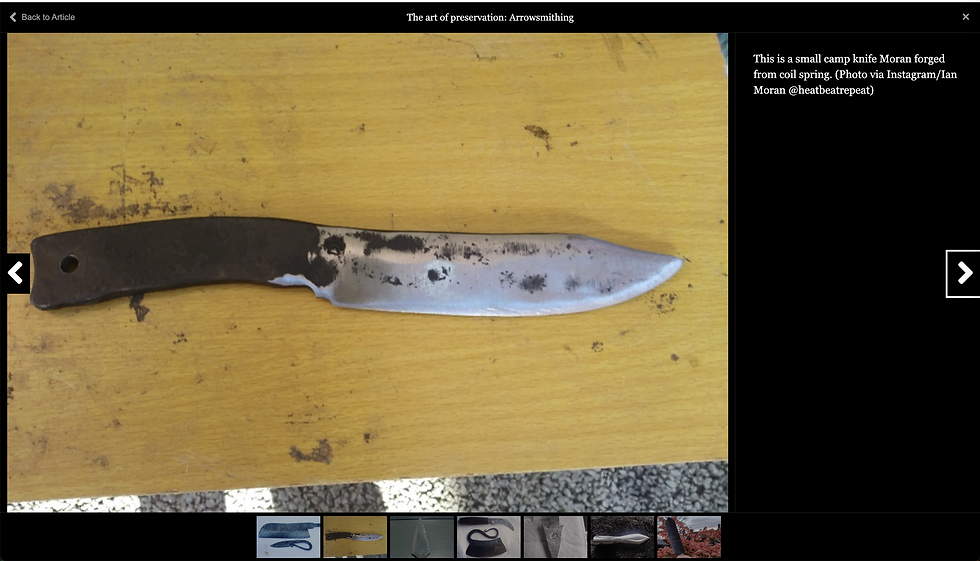
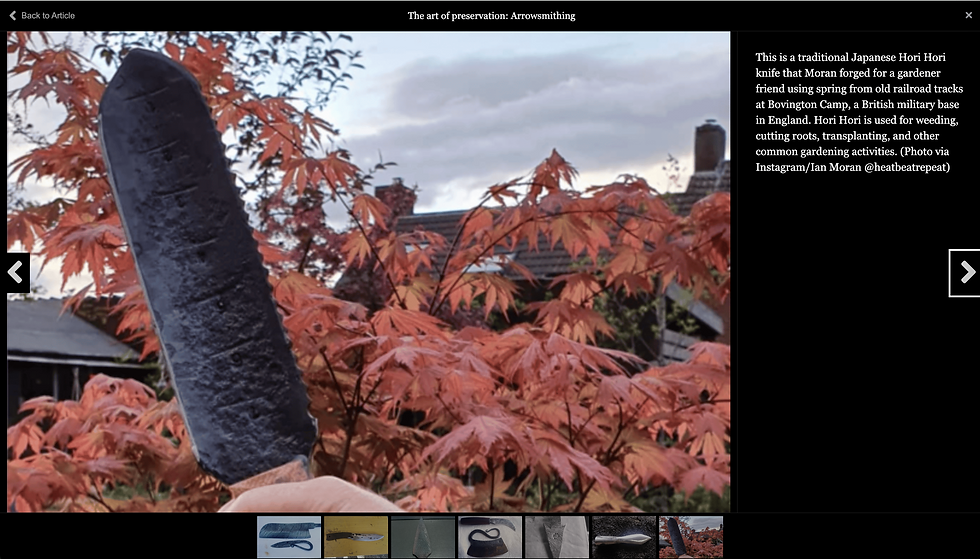
PHOTO GALLERY
KNIGHTLAB JUXTAPOSE

GENIALLY INFOGRAPHIC
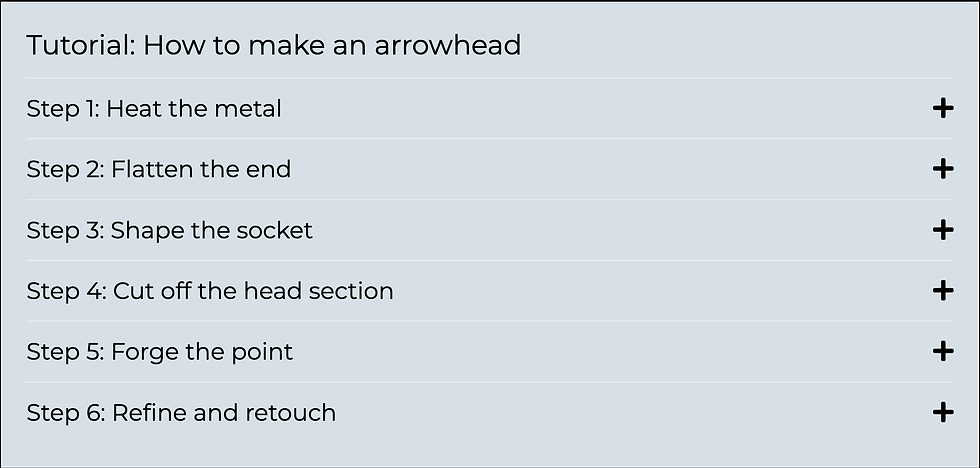
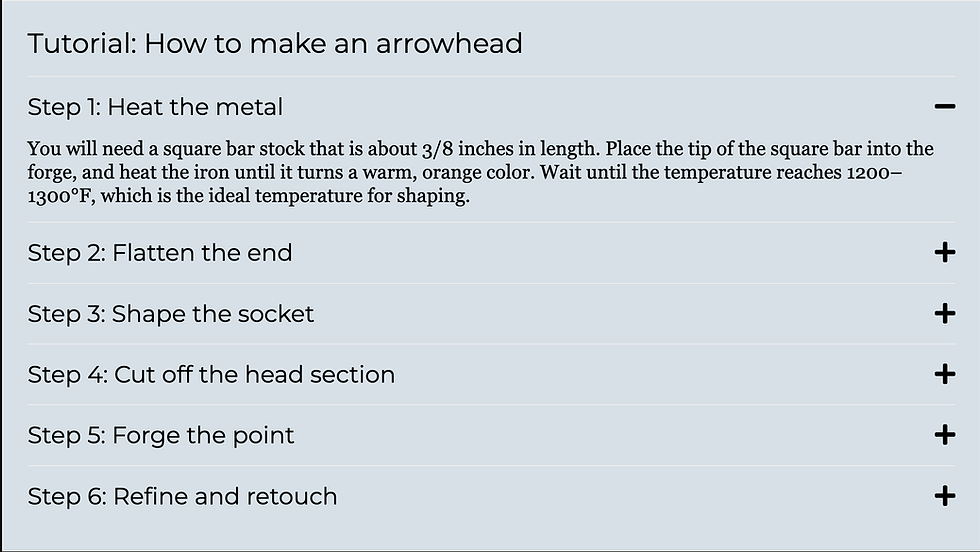

ACCORDION INFOBOX

ACCORDION INFOBOX

ACCORDION INFOBOX
FLOURISH CHART
FLOURISH CHART
FLOURISH CHART

GENIALLY INFOGRAPHIC

INLINE PHOTO
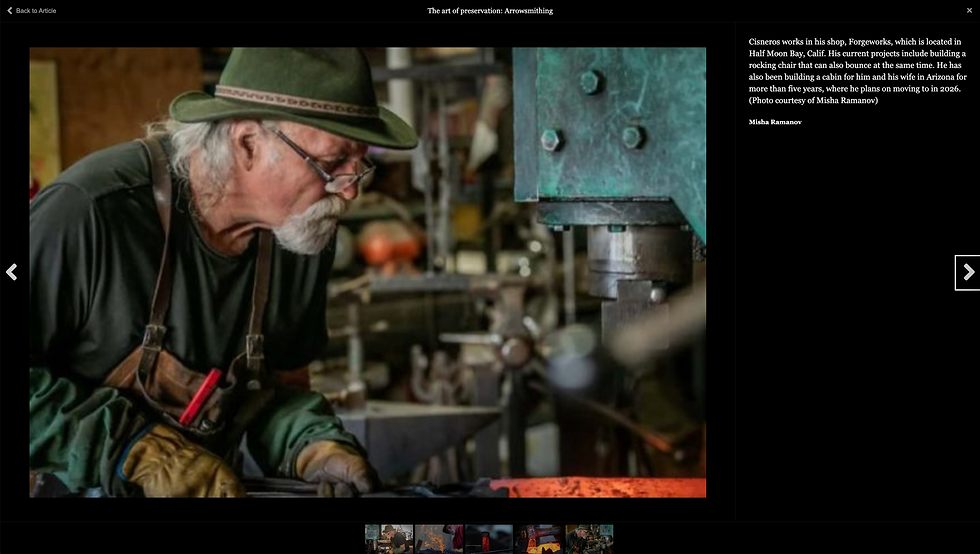
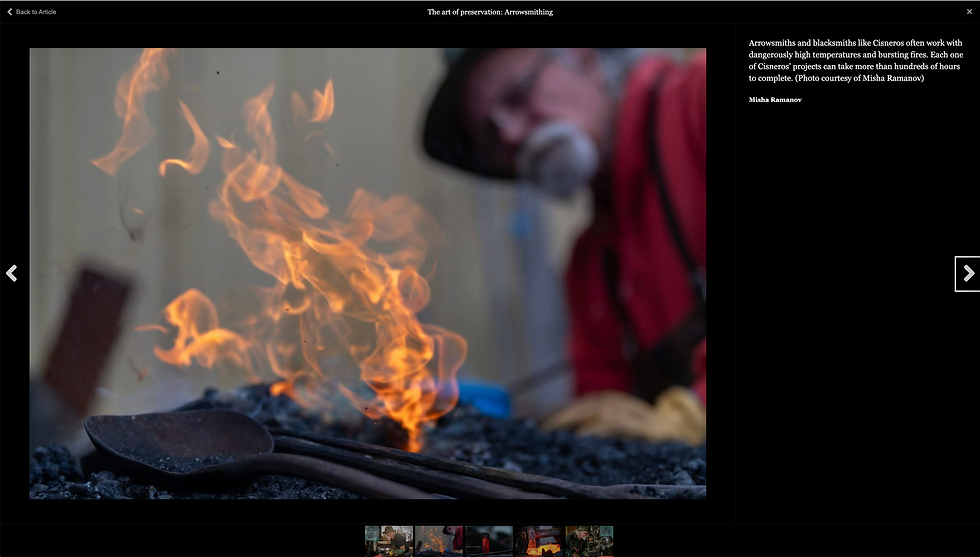
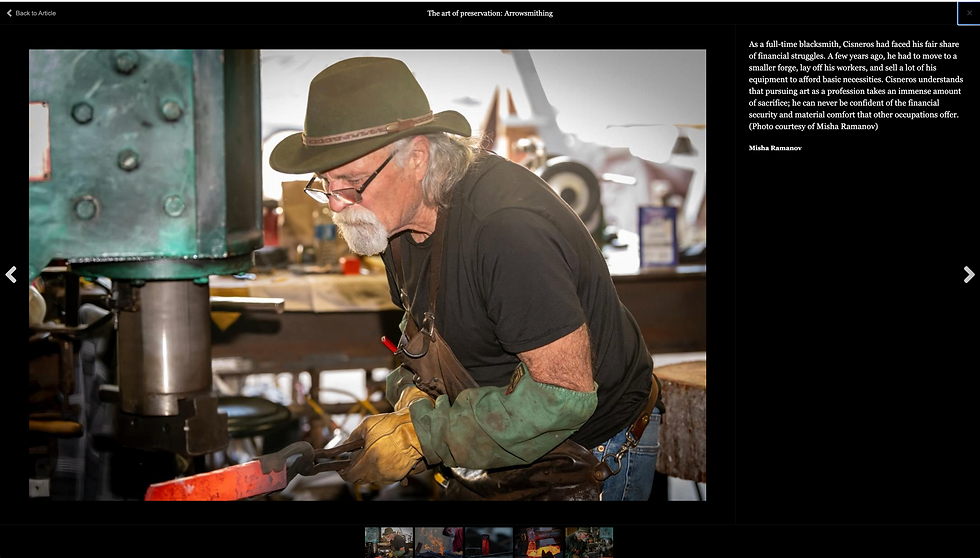
PHOTO GALLERY
The Bay Area is such a bubble — there are constantly new startups and technology terminology to follow. Anthropic this, CRISPR that, Nvidia, OpenAI, so on and so forth. It’s easy to be overwhelmed in a place where it seems like artificial intelligence is developing faster than the world around us — faster than our brains can comprehend.
For this multimedia feature, I wanted to go behind the scenes to explore something that many adolescents have forgotten how to do: crafting. The art of making something with your own hands is the epitome of being human in our most basic form, a living and working organism.
Thus, this feature highlights Ian Moran, one of the last arrowsmiths alive, following his journey in arrowsmithing. Moran provides unique insights into how modernization and the development of manufacturing have transformed the artisanal market, along with transforming the way that people interact with the products they consume. Additionally, I weaved in more professional and local perspectives from Becky Schimpff, the Education Chair of the Artist-Blacksmith’s Association of North America (ABANA); Katie Johnson, the Director of Programs and Events of the American Craft Council (ACC); Tiffany Karow, former public school teacher and owner of San Carlos Art Circles; and Jared Tolla, the assistant director of the UC Davis Craft Center.
Because this feature integrated information from dozens of interviewees and sources, I relied on multimedia to effectively communicate it to readers. This ranged from traditional accordion infoboxes to embedded Flourish line charts and bar graphs, to Knightlab Juxtapose, to built-in photo galleries, to Genially infographics. One example of how I sorted immense amounts of data into digestible multimedia is the conversion of Moran’s verbal explanation into a simple 6-step accordion infobox on how to make an arrowhead.
Additionally, it is important to note that this multimedia feature, “The art of preservation: Arrowsmithing,” is the first part of a multimedia feature package with two other articles, “The art of preservation: Fanmaking” and “The art of preservation: Glass eye making.” These two articles follow a similar format, taking the reader through the story of an expert in the art.
Through these diverse components, which converse like sources in an AP Research literature review, my final multimedia feature package consolidates human perspectives with secondary data, teaching readers that effort, not efficiency, is what it means to be human.


The art of preservation: Glass eye making
The art of preservation: Fanmaking
DATA JOURNALISM

Surviving suicide: The attempt and the aftermath
FLOURISH CHART
FLOURISH NUMBER TICKER
FLOURISH MAP
When I first interviewed Alissa Zhang* on her experience healing from a suicide attempt, I didn’t expect that the article would focus so much on the data aspect of mental health. With my careful presentation of the sensitivity of her story and the use of a pseudonym for anonymity, I expected that her words would outweigh the rest of the content.
I simply hoped that people who might be in a similar situation as she was would see themselves in her words and find the light at the end of the tunnel. However, what I underestimated was the power of the media to create tangible change — specifically by leveraging data journalism.
For example, I created a Flourish bar and line graph illustrating the rise in U.S. suicide rates since 2001, with a prevalent rise occurring after the COVID-19 pandemic. This visual spike effectively emphasized the urgency of the mental health crisis situation. Next, I incorporated a number ticker counting up to 720,000 — the number of lives that are taken by suicide each year. Additionally, I utilized information from the National Institute of Mental Health in an infographic on the symptoms of suicidal ideation, with the purpose that such a resource could help readers identify and mitigate potential ideation in their family and friends.
I also developed a map on Flourish highlighting the average number of suicides per 100,000 individuals in each state. You might notice that California’s number of 10.16 is significantly lower than the national average, but this does not necessarily apply to the Bay Area, where intensive schools like Gunn High School and Palo Alto High School are referred to as “suicide schools.”
Lastly, to address the high rates of suicide in adolescents, knowing that there might be someone reading my article who is contemplating that very decision, I included an accordion infobox at the end of my article with local and national mental health resources.
After seeing this article, The Felton Institute San Mateo Suicide Prevention reached out to help me create a Research & Education FAQ infobox with crisis support resources, and offered to pair Carlmont High School with mental health workshop sections. Furthermore, SafeSpace members interviewed invited Carlmont High School students to join their Youth Action Board.
As Aris Payan, the programs manager for SafeSpace, has said, San Mateo is not underresourced; it’s underutilized. It is this idea that has helped me recognize the greater need to speak up, to destigmatize adversity, to place youth at the forefront of the mental health conversation.
Our words are the catalysts for change.
AUDIO

The art of preservation
Episode 1
Episode 2
Episode 3
Have you ever met someone so passionate about a topic that they could just talk on and on about it forever? You hear it in the inflection of their voice, the cadence in speech, the rise in volume, words spilling over and over each other. Voices filled with unmistakable enthusiasm, voices as soft as the underbellies of leaves.
That’s how I felt when I was interviewing arrowsmith Ian Moran, fanmaker Lynn McMasters, and glass eye maker Hannah Bond. Even though each interviewee was practicing and preserving a different endangered craft, what they all had in common was the sincerity of their voices — the giddy stumbles and stutters that only come from talking about something you love.
Thus, I wanted readers to hear directly from these traditional artists, just like I did. I wanted them to feel the passion of dedicating oneself to a craft, but also the struggle of the sacrifice that comes with it.
Pathos is one of the most effective modes of rhetorical persuasion, and it is through candid, authentic, and raw audio that readers are able to realize, amongst an ever-evolving technological world, the importance of the traditional.
This podcast includes three episodes: the first being about arrowsmithing, the second being about fanmaking, and the third being about glass eye making. Besides traditional artists, this podcast also weaved in perspectives from other artisans and makers and non-profit crafts organizations.
VISUAL STORYTELLING


I am so beyond honored to have been the one to capture live photos of Carlmont High School’s anti-ICE walkout. I find that youth are often driven by emotional, passing outbursts of activism — easily swayed by sad videos and mass reposts on social media — rather than organized action. That’s why youth activism is often overshadowed by adult centrism, the idea that the adult way of solving problems is the superior norm.
However, Carlmont High School students’ ability to organize as a unity, with over a thousand students marching out of school in protest against ICE, is proof that youth are capable of long-term systematic change. And these photos immortalize the potential of youth activism.
This experience taught me a lot about the technical aspect of photography — rule of thirds, depth of field, leading lines, contrast — but also a lot about spontaneity. To get the best angles, I had to stand on the edge of train tracks, climb on top of walls, and snap photos in the middle of crossing the road. It was a new experience, but a very exhilarating one. And I would do it again in a heartbeat.
I was also able to connect with a student population that I don’t usually get to communicate with at school — English language learners, who proudly held up the Mexican flag and signs in Spanish to advocate for their communities. I have never seen and captured so much student determination in my life. When I look back on these photos, I am so proud to call myself a Carlmont Scot.
As newspaper editor Arthur Brisbane once said, a picture is worth a thousand words. It’s the restless smiles, soft hands raising up colored signs, heads peeking out from single-file lines, heads filling the frame like a sea. It’s these little things that are the most memorable, the fleeting faces, the ephemerality caught in an SD card and a moment of time.